QUALIFICATION SOVEREIGNTY.
Your lab, your people, your data, qualified on your soil. Raw data never leaves your facility. ASTRO engineers in Los Angeles provide independent sign-off on every certificate.
WHAT IS QUALIFICATION SOVEREIGNTY?THE MISSING LAYER OF INDUSTRIAL SOVEREIGNTY.
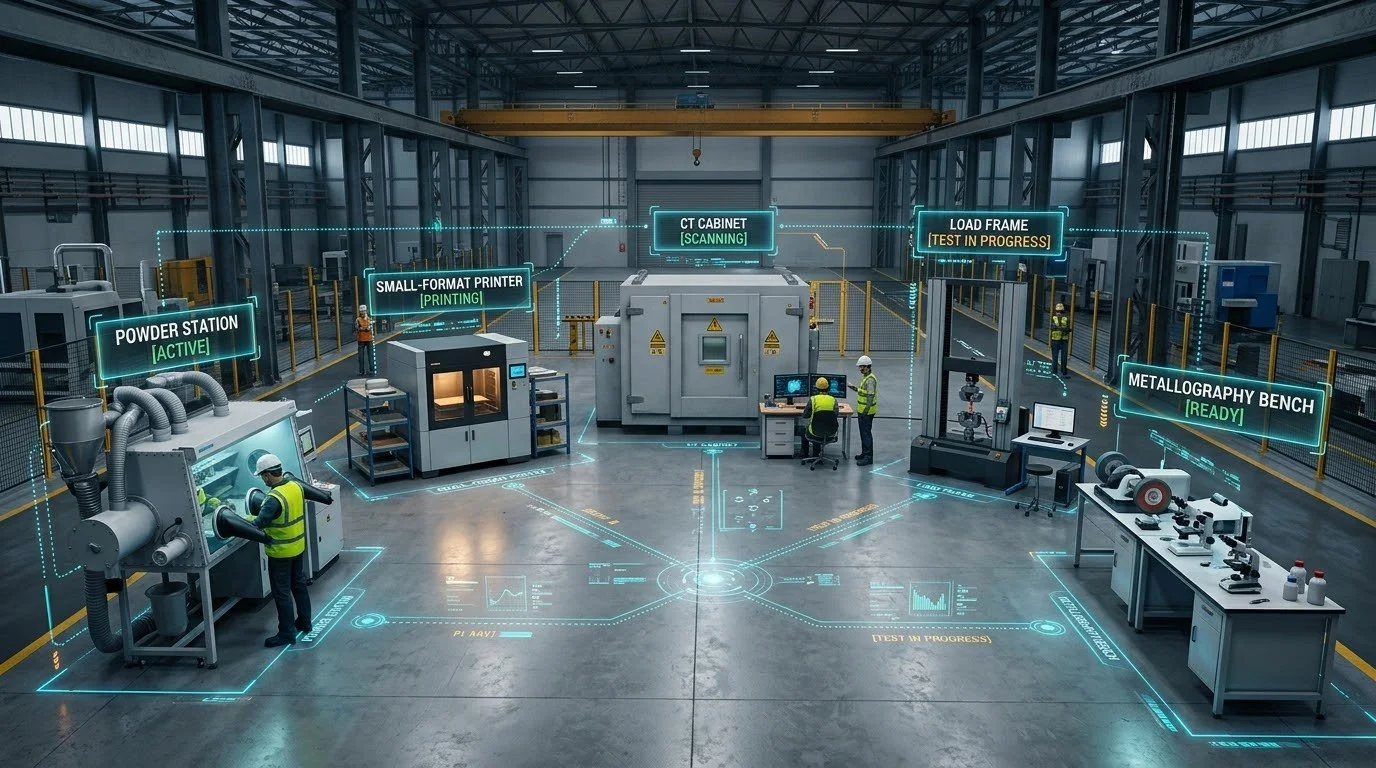
Qualification sovereignty is the ability to qualify your own materials, processes and parts without sending hardware or data out of the country. The ASTRO Deployable AM Qualification Lab delivers it: the equipment, methods and trained team sit inside your factory, while ASTRO provides independent engineering verification.
THE PROBLEMQUALIFICATION IS THE BOTTLENECK, NOT PRINTING.
Additive machines can now produce flight-relevant geometry in days. Qualifying the material, the process and the part still takes months. Coupons ship out, sit in queues and come back as PDFs that don’t connect to the build that made them.
Every OEM writes its own requirements. Suppliers pay to qualify with no guarantee of a contract. Innovators need validated material and process data before they can commit to application geometry. Generative design and FEA have moved ahead, but there is still a gap between what build simulation predicts and what the measured material actually does.
The Deployable AM Qualification Lab closes that gap by putting the proof next to the machine.
WHAT IT ISA LAB AT THE CENTER OF YOUR FACTORY, NOT A FACTORY REDESIGN.
ASTRO doesn’t design your factory. We put the qualification lab at its center. Each Deployable Lab is a turnkey, configurable installation with three parts:
-

Physical lab
A standard core of build, test, metallography and inspection equipment run by cobots, plus modular add-ons. ASTRO specifies and commissions everything.
-
Methods
ASTRO’s procedures for material qualification, process qualification and part conformance, built on NASA-STD-6030 and ASTM practice and adapted to your OEM and program requirements.
-
Evidence Intelligence
A software layer that ties each powder lot, build, coupon, scan and test into one traceable record, sends results to ASTRO engineers in Los Angeles for review and supports certificate sign-off.
LAB MODULESA STANDARD CORE PLUS MODULAR ADD-ONS
Every Deployable Lab is built around a standard core. Collaborative robots (cobots) run it, moving specimens from build plate to prep to test, so the lab can run lights-out with less hands-on technician time. Add-on modules extend the lab to the alloys, part classes and requirements of each program.
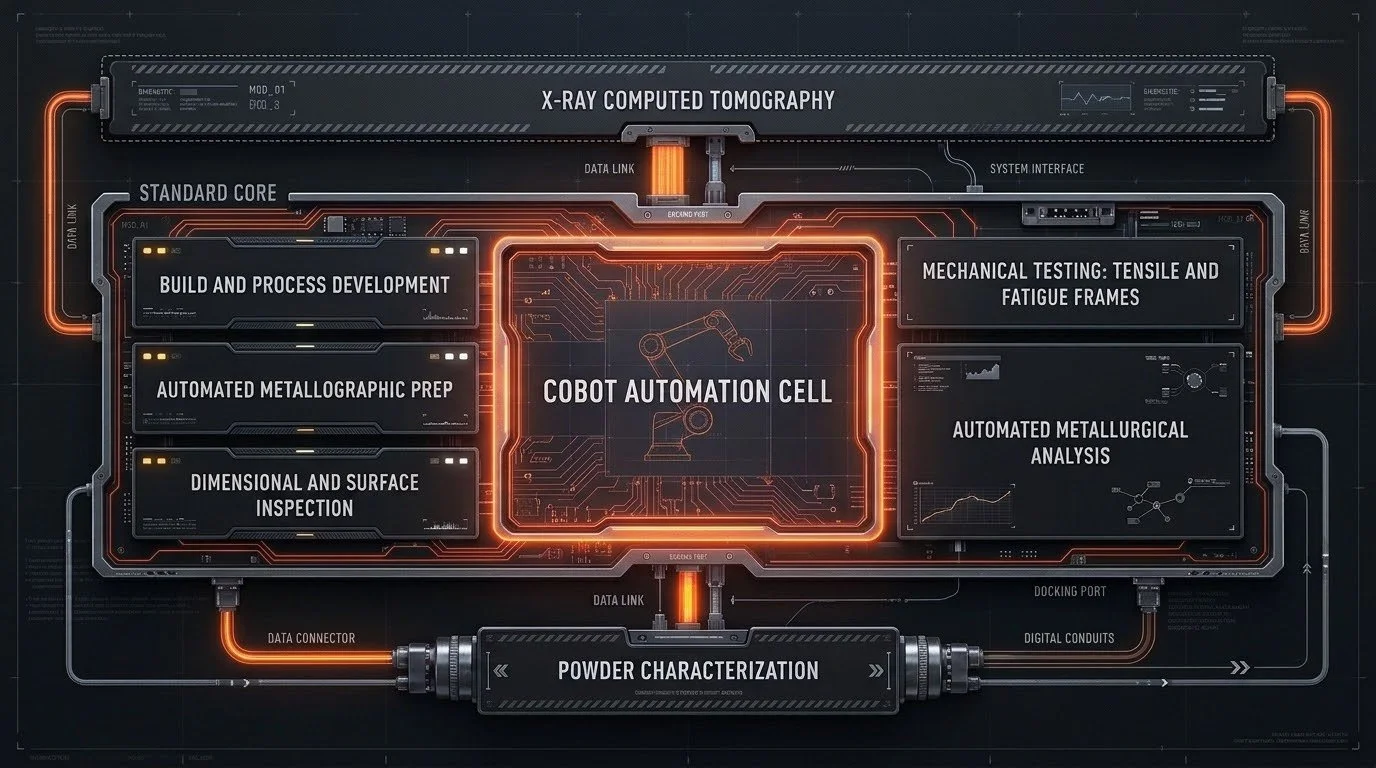
Standard Core
-
Cobot automation cell
Collaborative robots load and unload specimens on the test frames and move them between stations
Barcode/ID scanning at each handoff. Every movement is written to the digital thread
Scheduled queues run lights-out overnight and on weekends, so frames and prep equipment are used for more hours each day
Load, position and handling are the same for every specimen, which removes operator-to-operator variability
-
Build and process development
Small-format build platform for parameter sweeps, density cubes and witness coupons
Design-of-experiments planning for laser power, scan speed, hatch spacing, layer thickness and contour strategy
Process window mapping against density, surface and property responses
-
Mechanical testing: tensile and fatigue frames
Tensile frames for ambient tensile, yield, elongation, reduction of area and modulus (ASTM E8/E8M, ISO 6892-1, ASTM E111)
Fatigue frames for load-controlled high-cycle fatigue (ASTM E466) and strain-controlled low-cycle fatigue (ASTM E606/E606M)
Cobot-tended specimen loading, video extensometer and continuous testing in a queue
Raw load, displacement, strain and cycle data streamed straight into the evidence record
-
Automated metallographic prep
Automated sectioning, mounting, grinding and polishing (ASTM E3)
Programmed prep recipes for each alloy, with consumables and step times logged per specimen
Automated etching (ASTM E407) for repeatable surface preparation
-

Automated metallurgical analysis
Motorized optical microscopy with automated stitching of full cross-sections
Porosity and defect quantification by image analysis (ASTM E1245, ASTM E2109), with gas pores and lack-of-fusion classified separately
Grain size (ASTM E112, ASTM E1382) and melt-pool and phase features, measured by ML image models
Automated microhardness traverses (ASTM E384, ASTM E92)
-
New List Item
Laser and optical 3D dimensional inspection with CAD comparison and GD&T reporting
Areal and profile surface roughness (ISO 25178, ISO 21920 / ASME B46.1)
First article inspection as the part-qualification gate
Modular Add-Ons
-
X-ray computed tomography
Volumetric detection of porosity, lack of fusion and inclusions, plus verification of internal channels and lattices
ML defect segmentation, with defect size, shape and location checked against acceptance criteria
Voltage class and shielded cabinet chosen to suit part size and alloy density (aluminum through nickel superalloys)
-
Powder characterization
Particle size distribution by laser diffraction or dynamic image analysis (ASTM B822, ISO 13322-2)
Morphology, aspect ratio, sphericity, satellite and agglomerate fraction
Apparent density (ASTM B212 / B417), tap density (ASTM B527), Hall and Carney flow (ASTM B213 / B964)
Moisture and lot-to-lot reuse tracking, per ASTM F3049 guidance
WHAT WE QUALIFYMATERIAL DEVELOPMENT PORTFOLIO
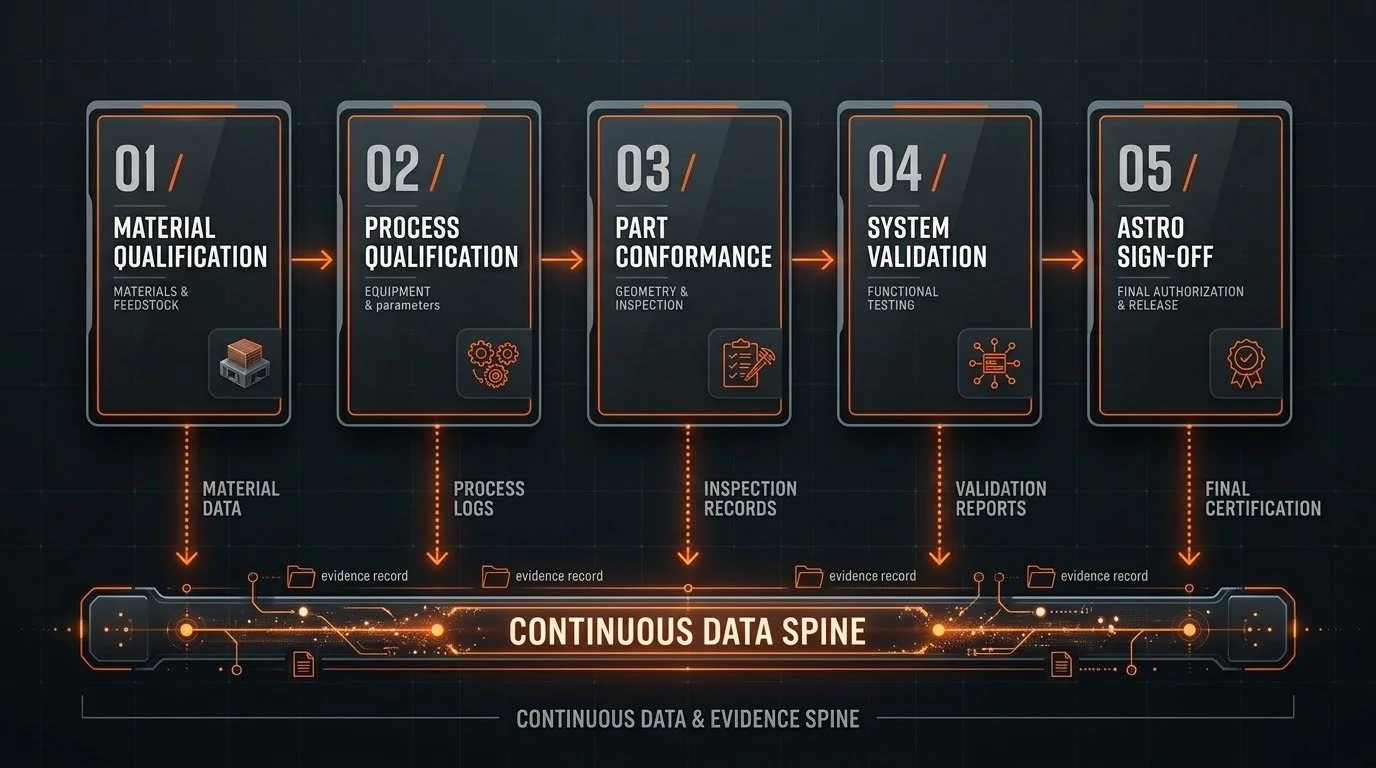
| Stage | Question It Answers | Typical Evidence |
|---|---|---|
| Material qualification | Is this feedstock what we think it is, and does it stay that way? | Chemistry certs, PSD, flow, density, reuse lineage |
| Process qualification | Does this machine, parameter set and post-process reliably produce the required material? | Density cubes, witness coupons, tensile/fatigue lots, microstructure, machine-to-machine comparison |
| Part conformance | Does this part meet the drawing and requirements? | FAI, CT, dimensional reports, surface data, witness coupon results |
| System validation | Does it perform in the assembly and environment? | Proof, leak, thermal cycling and functional test data |
| ASTRO sign-off | Is the evidence complete and within requirements? | Reviewed data package and signed certificate |
EVIDENCE INTELLIGENCEEVERY COUPON MAKES THE NEXT DECISION SMARTER.
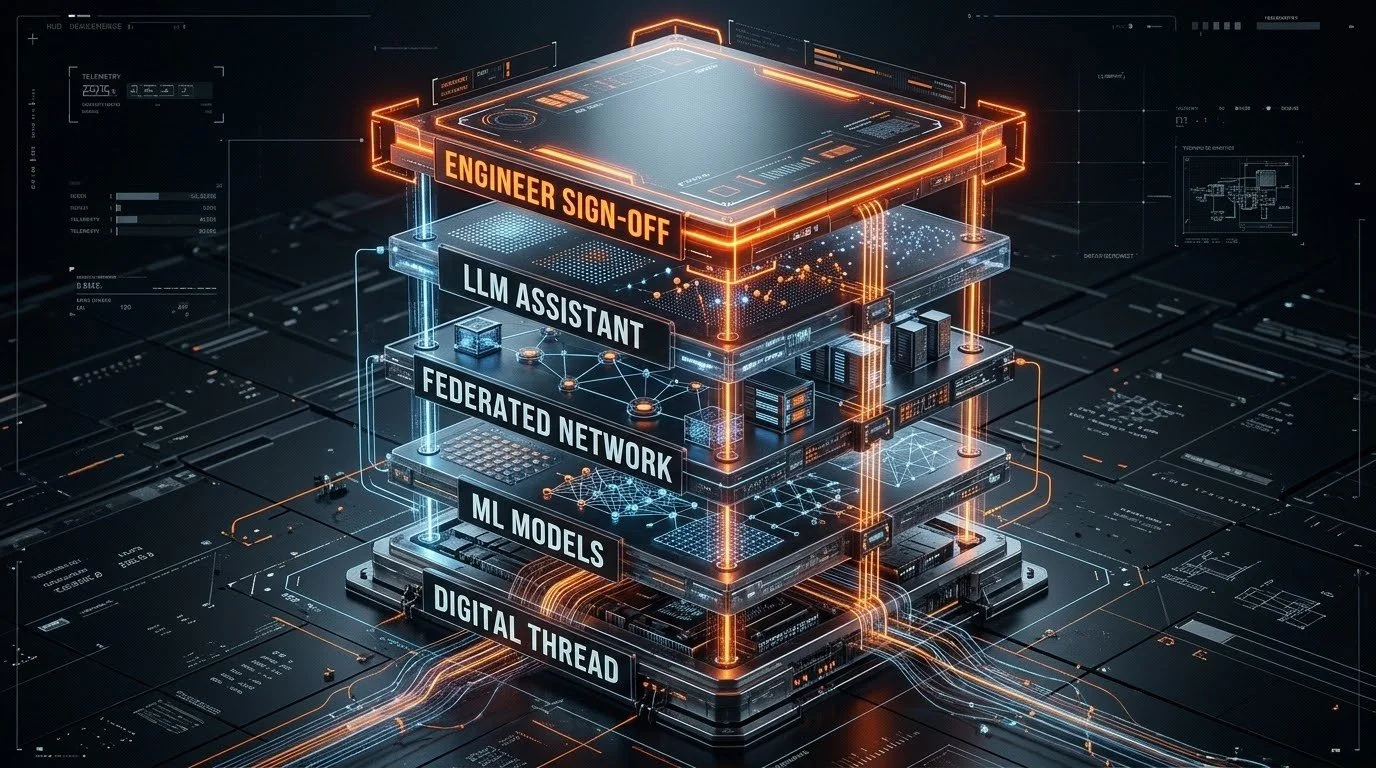
Each Deployable Lab runs on ASTRO’s qualification intelligence platform. It combines a digital thread, machine learning models trained on physics, a federated learning network and a large language model engineering assistant. The AI speeds up planning, analysis and documentation. Sign-off always stays with ASTRO’s engineers.
-
Layer 1: Digital Thread and As-Built Digital Twin
Every object in the lab gets an ID and links to everything before and after it:
Powder lot, chemistry certificate, PSD and reuse history
Machine, build file, parameter set, scan strategy, plate layout and in-situ build logs
Coupon and part location, orientation and post-processing history (stress relief, HIP, heat treatment, machining)
CT volumes, dimensional scans, surface data, micrographs, raw test curves
Together these build an as-built digital twin of each part and coupon, a queryable record of how it was made and how it measured. Any value on a certificate can be traced back through the twin to the powder lot and build behind it.
-
Layer 2: Machine Learning Models
The models start from physics and add data-driven learning, so they can make useful predictions from the small data sets typical of qualification:
Process-property prediction. Physics-informed Gaussian process regression predicts density, tensile and fatigue response from process parameters, energy density, geometry and post-processing, with uncertainty bounds on every prediction.
Parameter optimization. Bayesian optimization recommends the next set of parameter-sweep experiments. This reduces the number of builds and coupons needed to define a process window.
Defect detection on CT data. Computer vision models segment and classify volumetric defects (gas porosity, lack of fusion, keyhole pores, inclusions) and measure size, shape and location against acceptance criteria.
Microstructure analysis. Image models measure porosity fraction, grain size and phase features from micrographs, consistently from one operator and one lab to the next.
Build anomaly detection. Unsupervised models flag unusual behavior in machine logs and in-situ monitoring data before the parts reach the test lab.
Pass/fail screening. Gradient-boosted classifiers screen parts and coupons once enough labeled results exist. Every prediction is shown alongside the physical features behind it.
Uncertainty first. Each model reports how confident it is. Low-confidence results go to physical testing instead of being accepted.
-
Layer 3: Federated Learning Network
Every Deployable Lab is a node in the ASTRO network.
Models train locally on each lab’s own data.
Only model updates (learned weights and statistics) are shared with the network. Each customer’s raw data, part geometry and build files stay in that customer’s lab.
The network model learns process-property relationships across alloys, machines and sites. Each new lab starts with the knowledge of the whole network instead of starting from zero.
Comparisons across machines and sites show where a process drifts, so variability is caught early.
-
Layer 4: LLM Engineering Assistant
A large language model trained on qualification work, connected to the lab’s evidence record and the governing standards:
Qualification planning. Turns a requirement, such as “qualify Inconel 718 on this machine to NASA-STD-6030,” into a draft test matrix, coupon count, build layout and schedule.
Spec-aware retrieval. Answers plain-language questions against the lab’s own data and the standards behind it, and cites the record or clause each answer came from.
Data review. Compares measured results with acceptance criteria and points out deviations, outliers and missing evidence.
Documentation. Drafts test reports, nonconformance reports and release packages for engineers to review.
Root-cause support. Links a failed coupon to its CT data, fractography, build log and powder lot, and suggests hypotheses for engineers to test.
Engineer Sign-off
The AI recommends and engineers decide. Every disposition and certificate is reviewed and signed by ASTRO engineers in Los Angeles. Each model output is versioned and logged with the inputs it used, so every decision can be audited.