BORN AS THE FIRST LABORATORY DEDICATED TO AM QUALIFICATION. NOW QUALIFYING WHATEVER COMES NEXT.
Built for Every Critical Industry that is Innovating
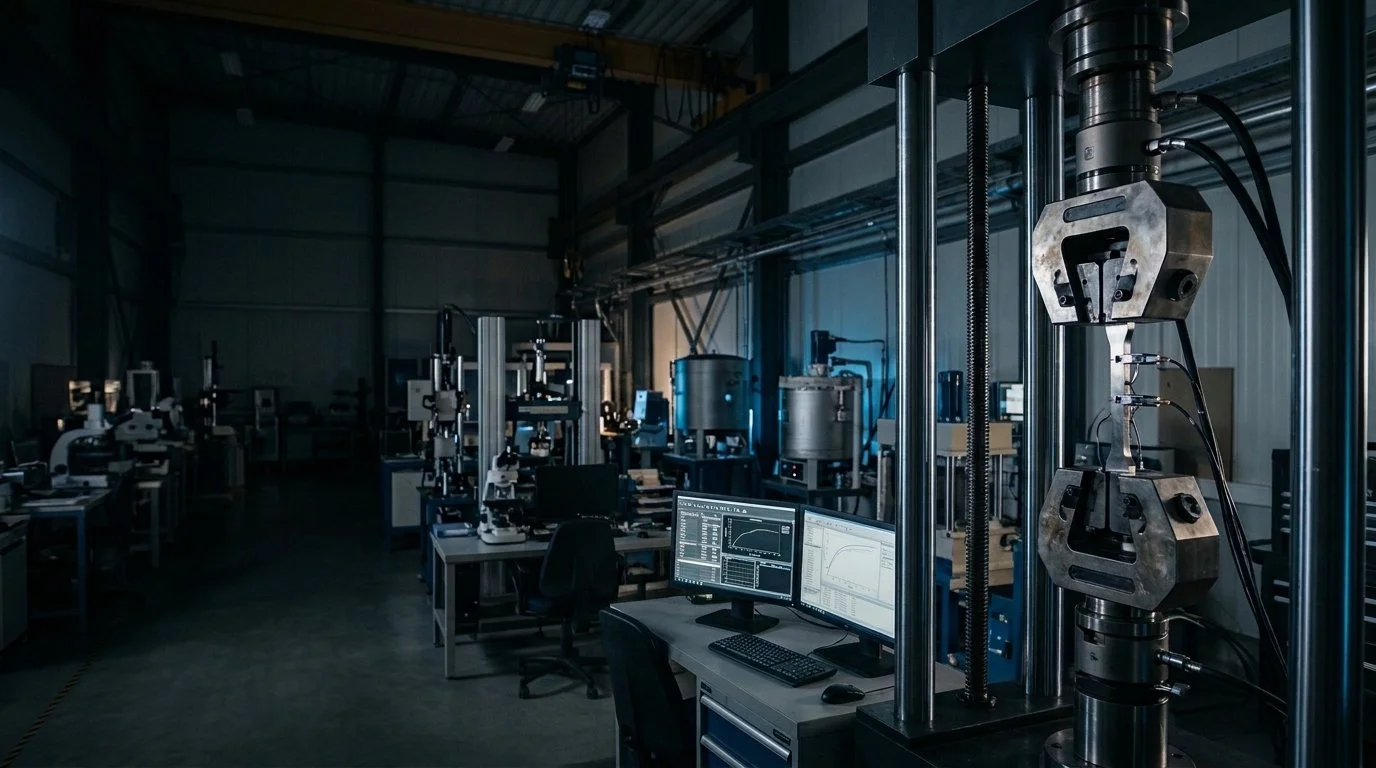
ASTRO is a Los Angeles engineering company that qualifies materials, processes and parts, whether additively manufactured, casted, forged, machined or joined, for aerospace, space, nuclear, energy, EV and robotic applications. We test to the governing standard or your own procedure, report in your format and keep every specimen traceable.
MECHANICAL TESTING
Tensile
| Test | Standard | Notes |
|---|---|---|
| Room-temperature tensile, metals | ASTM E8/E8M, ISO 6892-1 | Round and flat specimens. Yield (0.2% offset), UTS, elongation, reduction of area, modulus |
| Elevated-temperature tensile | ASTM E21, ISO 6892-2 | Elevated temperatures per ASTM E21. Furnace with multi-zone control, high-temperature extensometry |
| Cryogenic tensile | ASTM E8/E8M | LN2 immersion down to −196 °C (77 K). Propellant-relevant temperatures for LOX and LCH4 hardware |
| Modulus | ASTM E111 | |
| Polymer tensile | ASTM D638, ISO 527 | SLS, FDM, SLA and molded plastics |
| Composite tensile | ASTM D3039 | Polymer matrix composites, including continuous carbon-fiber and fiber-reinforced AM materials |
Fatigue
| Test | Standard | Notes |
|---|---|---|
| High-cycle fatigue (load-controlled) | ASTM E466 | Constant amplitude, R-ratio as specified, run-outs to 10⁷ cycles or as specified, S-N curve generation |
| Low-cycle fatigue (strain-controlled) | ASTM E606/E606M | Fully reversed or mean-strain, hysteresis and cyclic stress-strain response, ε-N curves |
| Elevated-temperature fatigue | ASTM E466, ASTM E606/E606M | High-cycle and low-cycle fatigue at elevated temperatures |
| Cryogenic fatigue | ASTM E466, ASTM E606/E606M | High-cycle and low-cycle fatigue with LN2 immersion down to −196 °C (77 K) |
| As-built vs. machined surface fatigue | Per program | Quantifies the surface-roughness knockdown typical of AM |
Compression, Bend and Impact
| Test | Standard | Notes |
|---|---|---|
| Compression, metals | ASTM E9 | Lattice and porous structures by agreement |
| Compression, polymers | ASTM D695 | |
| Bend / guided bend | ASTM E290 | Ductility checks for welds and AM material |
| Flexural, polymers | ASTM D790 | 3-point and 4-point |
| Charpy V-notch impact | ASTM E23 | Ambient and low-temperature testing, with LN2 conditioning down to −196 °C (77 K). Absorbed energy, lateral expansion and percent shear fracture |
| Izod and Charpy impact, polymers | ASTM D256, ASTM D6110 | Notched specimens. SLS, FDM, SLA, composite and molded plastics |
Hardness
| Test | Standard |
|---|---|
| Rockwell (A, B, C, superficial) | ASTM E18 |
| Vickers and Knoop microhardness, traverses and case-depth profiles | ASTM E384, ASTM E92 |
| Brinell | ASTM E10 |
| Shore durometer, polymers | ASTM D2240 |
| Hardness conversion | ASTM E140 |
Pressure and Component Testing
Hydrostatic test rigs designed and built in ASTRO’s lab and machine shop for AM propulsion tanks, manifolds, injectors and fluid components. Test pressures, hold times and acceptance criteria are set by your requirement.
- Hydrostatic proof. Pressurized with water to the specified proof factor and held, with pressure decay and permanent deformation recorded.
- Hydrostatic burst. Pressure ramped to failure, with burst pressure and failure location recorded.
- Leak testing. Hydrostatic leak checks for wall porosity, seal and joint integrity.
- Pressure-cycle fatigue. Repeated hydrostatic pressure cycles to a specified count or until failure.
- Flow testing. Water flow characterization of orifices, channels and injector elements.
All pressure, time and cycle data is logged and linked to the part’s build record, so test results can be traced back to inspection findings, wall thickness and post-processing.
METALLURGICAL & MATERIALS ANALYSIS
| Analysis | Standard / Method | Output |
|---|---|---|
| Metallographic preparation | ASTM E3 | Sectioning, hot/cold mounting, grinding and polishing to a defect-free surface |
| Microstructural analysis | ASTM E407 (etching) | Melt-pool morphology, columnar vs. equiaxed grains, α/β morphology (Ti), δ/γ″/Laves phases (Ni), precipitate distribution |
| Density | ASTM B962 (Archimedes), ASTM B311 | Relative density vs. theoretical |
| Porosity / defect quantification | ASTM E1245, ASTM E2109, image analysis | Area fraction, pore size distribution, gas pore vs. lack-of-fusion classification |
| Grain size | ASTM E112, ASTM E1382 | Intercept or planimetric, by build direction |
| Surface roughness | ISO 21920 / ISO 4287, ISO 25178, ASME B46.1 | Ra, Rz, Sa, Sz on up-skin, down-skin and side-wall surfaces |
| Surface contamination | Visual and microscopy per program | Partially fused particles, residual powder, oxide |
| Phase identification | Metallography, microhardness. XRD through partners | Phase formation after build and heat treatment |
| SEM / EDS | Through partner laboratories | Fractography, powder morphology, elemental composition of powder and printed coupons |
| Chemical analysis | Through partner laboratories | ICP-OES, combustion (C/S), inert gas fusion (O/N/H) |
| Fractography | Optical stereo. SEM through partners | Initiation site, fracture mode, defect correlation |
Powder Characterization
| Property | Standard |
|---|---|
| Particle size distribution (D10/D50/D90) | ASTM B822 (laser diffraction), ISO 13322-2 (dynamic image analysis) |
| Morphology, aspect ratio, sphericity | Image analysis. SEM through partners |
| Apparent density | ASTM B212, ASTM B417 |
| Tap density | ASTM B527 |
| Flowability | ASTM B213 (Hall), ASTM B964 (Carney) |
| Powder reuse and lot tracking | ASTM F3049 guidance, program-specific |
SPECIMENS MADE TO SPEC, IN-HOUSE.
ASTRO’s CNC machine shop makes test specimens to the geometry, tolerance and surface finish the standard requires, so preparation doesn’t become the source of scatter.
- CNC turning and milling. Round tensile, fatigue and LCF specimens per ASTM E8, E466 and E606, with controlled low-stress finishing passes.
- Wire EDM. Coupons extracted from build plates and parts with minimal heat-affected material, for location-specific properties.
- Fatigue-grade finishing. Longitudinal polishing to the specified surface roughness, with Ra verified and recorded before test.
- Charpy V-notch. Notch geometry verified per ASTM E23.
- As-built specimens. Surfaces kept and documented to quantify AM surface effects.
- Build-plate mapping. Coupon ID, location and orientation (XY, Z, 45°) recorded for each specimen.
- Heat treatment. Stress relief, HIP, solution and aging through qualified external partners, coordinated and documented by ASTRO.
THERMAL CYCLING AND ENVIRONMENTAL CONDITIONING
Internal thermal cycling and conditioning ovens for materials, coupons and assemblies.
- Thermal cycling. Programmable hot/cold profiles to your requirement. Temperature extremes, ramp rates, dwell times and cycle counts are set per program, followed by inspection and mechanical testing to measure property retention.
- Conditioning. Temperature and humidity conditioning before testing, per ASTM D618 for polymers.
- Pre- and post-cycle evaluation. Dimensional change, metallography, hardness, tensile.
REPORTING & DATA
- Specimen-level traceability: material lot, build ID, plate location, orientation, post-processing and machining history
- Raw data (load-displacement, strain, cycle counts) delivered alongside summary reports
- Statistical summaries for allowables development, including mean, standard deviation and A/B-basis inputs
- Reports to ASTM, ISO, NASA-STD-6030 / 6033 and customer formats